

A compendium of images - most original, some not - words, and links, sometimes musical, gathered for the exclusive enjoyment of friends and relatives, some old, and some new.
And so we end our Thanksgiving holiday weekend. Our granddaughter was home from college to spend some time with us, and her sister and dad. We had some great meals, and then the womenfolk did some holiday shopping to take advantage of the bargains. The weather was fine till today, when the first rain finally arrived.
Like most men, I do not much enjoy shopping. If I needed to buy something, I'd go to the store that sold it, buy it, and come right home. The thought of wandering from store to store looking at shoes, or apparel, or household items is enough to tax my equilibrium to the fullest. Nowadays, of course, we can buy almost anything online. But the women of my acquaintance seem not to like that alternative. They like to feel the cloth, try on the shoe, and check the shade or color of this fabric against that accessory. They are able to spend many hours doing stuff like this. They enjoy shopping, especially at this time of year, when there are bargains galore. Why, just in today's (Sunday's) newspaper the sales ads outweigh the news pages and other sections by a significant margin. What joy it must be for our shoppers to negotiate all those department store aisles in search of bargains!
* * * *
Many homes in our neighborhood are already decorated with lights for the holidays. Some are really very elaborate. Not all are in the best of taste. Well, chacun a son goût. What else can one say?
I'm wearing a new shirt for Thanksgiving. It has a checked pattern, button down collar, and, for a storebought shirt, it fits quite well. The label at the back of the neck has a well-known brand on it. But, as with most apparel these days (at least the kind that I'm likely to buy off the rack), it was made overseas. In this case, Cambodia. The label tells me this in English, and also in Spanish ("hecho en Camboya"), the latter, we may suppose, for the benefit of the many people in this country for whom the Spanish language is the preferred medium of communication.
One could go on at length about the marketing of apparel with well-known American brand names, about the transfer of manufacturing to countries with cheaper labor costs, about perceived corporate greed for higher profits and an improved bottom line. But one chooses not to enter that arena.
Let us instead examine the shirt itself. Quality of the material is very good. The sewing of the pockets and the collar and the buttonholes and the sleeves happens to be fair. There are some hanging threads here and there, which must be carefully trimmed away with my wife's nail scissors. Sometimes the buttons are not sewn as securely as one might have expected, but that failing is easily remedied with thread and needle.
The shirt as it comes is neatly folded. A cardboard insert keeps the whole thing stiff and easy to handle. The problem though is that there are a number of pins that hold the fabric so that it retains its tidy rectangular shape against the cardboard. Some pins pierce the fabric as well as the cardboard, others may pin a sleeve to a breast pocket, and still others are hidden in such a way that an unsuspecting person could easily prick a finger in trying to find out how they are attached. Care has to be exercised to avoid such occurrences.
Now, something about those pins. In a quality shirt, the pins are likely to have large round heads, so that they can easily be distinguished by clumsy male fingers from the sharp, pointed end. Cheaper shirts may have pins with old-style tiny heads. These are more dangerous.
On an average man's shirt, there may be as many as ten pins. In the past I have simply discarded the pins, including the large roundheaded ones, by dropping them in the wastebasket. Then one day my wife told me that she could use those pins, so now I collect them every time I open up a new shirt. I place them in an empty film canister (speaking of which, these are fast becoming a rarity with the demise of film as a photographic medium), and when enough of them are collected, the pins end up in the embroidered pin cushion (made in the shape of a colorful turtle) in her sewing box.
Here I will stop and wish everyone a very happy Thanksgiving, as I put on my new shirt.
The waiting room is small by the standards of an office with seven doctors' names on the door. There are about thirty steel chairs with fabric seats and backs, in color either black or blue, along with three plain black cube-shaped tables. Current issues of magazines are laid out in haphazard fashion on the tables. Some magazines occupy the chair seats where their readers have hastily left them upon being summoned into their examination rooms. The magazines to which the doctors subscribe may reveal as much about them as about their patients. There are the regulars: Time, Fortune, Business Week, US News and World Report, Sunset, Health, Sports Illustrated, Golf, which one tends to find in most doctors' waiting rooms. There are the ones that appeal to a younger readership: Wired, People, Entertainment Weekly, In Touch ("Who's Britney dating?'). Then there are the magazines aimed at a more affluent clientele: Vanity Fair, Esquire, Southern Accents, Cottage Living, Yachting. Powerboating.
The room is crowded when I first get there. I understand that Mondays are like that. Generally the patients are quietly reading, awaiting their summons. It's cold today, and most of them are warmly clothed.
Two women behind me are engaged in an animated, if one-sided, conversation. The subject is an accident involving a drunken teenager who had crashed into the parked car of a friend of one of the women. No one was hurt, but the car was totaled, and the young man was subsequently arrested. He had no insurance. What is odd about this conversation is that the woman telling it gets no chance to finish any sentence before her (supposedly) attentive listener cuts in with a request for elaboration, an unrelated question, a non sequitur, an inane aside, or some other meaningless interruption. Both women speak in loud tones, as if they were not sitting in a small quiet room, but outdoors on a park bench in the midst of traffic.
At first I do not risk a look in the direction of the conversing women. We are sitting back to back. But through the ruse of looking for another magazine, I get up and glance at them. The one telling about the accident is a large woman in her fifties, with black hair that is wild and frizzled and extends out to either side of her broad face like a woman in the Fusco Brothers comic strip. Her companion is perhaps a couple of decades older, stooped, with stringy blond hair and a beak of a nose. She is the Constant Interrupter.
The two do not appear to be related, except perhaps that the dark-haired one may have brought the older woman for her appointment at this office. By this time the conversation has transmogrified to a discussion about a television soap opera, and the new satellite TV service that the blond woman has just installed at her place, and about how the remote controls that used to work on her TV now no longer work. This is the Constant Interrupter speaking in a complaining tone, and it is the dark-haired woman's turn to interrupt her with 'Did you try doing this or that?' and 'Was it the black remote or the one with the yellow buttons?'
Finally the nurse calls out a name, the blond woman cackles once, rises, is followed by her companion through the door held open for them, and a deathly stillness descends again upon the waiting room.Our fall days here have been just glorious. I'm sure they are in other places as well. But the Bay Area is hard to beat. (So much for Chamber of Commerce promotion.)
* * *
The ol' back is still not one-hundred-percent, but I'll live.
* * *
Started reading 'Mysteries of the Middle Ages' by Thomas Cahill, subtitled 'The Rise of Feminism, Science, and Art from the Cults of Catholic Europe"'. An absolutely fascinating book. Scholarly yet light in tone, an eye-opener upon a period in history that most of us don't often read about.. The 4-color illustrations and pithy footnotes are delightful. Some years ago I read Cahill's `'Desire of the Everlasting Hills', a study of Jesus in a historical context that was another page-turner.
By the way, did I mention Lawrence Wright's 'The Looming Tower — Al-Qaeda and the Path of 9/11'? Another must-read.Thanks to all who have looked in from time to time, and apologies for having left my blog unattended for a while. Truth is that I've been physically out of commission (and condition) the past couple of weeks, beginning with the virus I mentioned earlier. Now with antibiotics, the initial problem seems to have been taken care of. I say "seems" because I've yet to check in with the ENT guy following the ten-day course of medication he prescribed. I see him Monday.
How does one describe pain? Not easy, is it? Sometimes I think that the worst kind of pain is the kind that takes over your nervous system, which no positional adjustment can alleviate. Low back pain, the proverbial 'pain in the neck', joint pain, muscle pain. I'm not talking just average, plain vanilla, once-in-a-while pain. I'm talking serious, sharp, piercing, constant, can't-hold-your-head-up-because-your-head-feels-like-a-ripe-watermelon-about-to-be-separated-from-the
thin-vine-that-is-your-neck kind of pain.
So, what did I do? I visited this acupuncturist. Young guy from China, has a small store-front office on a shopping street not to far from where I live. Had seen him before for back pain. Had gotten some relief. Getting in and out of the car took some careful maneuvering. Two sessions with him. Four needles on the back of each hand, another couple on the instep of each foot. Twenty minutes lie-down. Needed help to get on and off the exam table.
Relief was brief. Pain returned not long after I got home. At the second session he tried to stretch and twist my neck. Mistake. I ain't going back to him no more. Or at least I don't think I will.
Finally I called my ENT guy to see if I could resume a medication that had previously been prescribed for pain relief. Thing called gabapentin, used for control of seizures and nerve pain. It's working so far.
This is the longest session I've spent at this keyboard in over a week. Better not overdo it.
Will try and check in later.
Inevitably it had to happen, I suppose. It wasn't the flu, although the season has already arrived. It was something else. It started with a sore throat and then mutated into something rather more alarming. Had difficulty swallowing, and overnight the side of my throat grew into a large, fleshy lump which was unsightly, to say the least. Threw the perfect symmetry of my countenance into a lopsided caricature of a double chin that seemed to be in the wrong place. Did I say it was alarming? Yes, all right, it was.
My E.N.T. doctor took a look and prescribed a course of antibiotics. Two days later, the thing has subsided a bit, and no longer looks quite so horrible. The doc did provide a modicum of assurance that he thought my deepest fears were unfounded, but he also said that he'll take another look when I finish taking the pills. We hear nowadays about people who get a virus, and in a very short time, it's curtains. Without the doctors even knowing what sort of virus it may have been. That's the world we live in nowadays. A world of nefarious and dangerous things sharing the air we breathe.
So this is my reason for not posting to this blog. You'd think that with all this sitting around at home, I'd think of something to post other than the foregoing. But so far I have not.
Stay tuned, though, won't you?It has been another busy week. This past weekend saw the wedding of my wife's niece at a scenic and celebrated location in The City. The weather was perfect (again), and the ceremony, conducted by the bride's cousin, proceeded flawlessly. At the reception we were introduced to relatives and friends from both sides. Some of the people had come from as far away as England, Canada, New York, and Washington State. The bride looked radiant. The groom was his usual amiable self. The newlyweds had planned every last detail of the ceremony and reception, but they had some help from the bride's sister.
* * * * *
In the days following, we entertained several of the out-of-town visitors, and in turn we were entertained by other family members who live in the vicinity. Weddings are of course wonderful venues to meet new friends and young people. They also provide many opportunities to reminisce about old times with relatives of our own vintage. Conversations that carry on far into the night are to be anticipated as well, and we certainly had more than our share of those.
* * * * *
The past two weeks have been especially busy, what with houseguests and visitors from overseas, more than the usual number of dinner parties and restaurant meals, and much shuttling back and forth between our house and the recently acquired pied-à-terre across the Bay. We must have put many hundreds of miles on the odometer in a week or so. Good thing gas prices have come down a bit.
The weather has been fine, except for an overcast sky today. Our guests left this morning. This is the first opportunity to add to my blog since they arrived.
* * * * *
I'm reading Lawrence Wright's new book "The Looming Tower — Al-Qaeda and the Path of 9/11". It's well researched and the author's writing style makes for easy reading. I recommend it highly to anyone wanting a clear yet concise overview of the events that have led to the current confrontation between radical Islam and the West.
* * * * *
Friends from distant lands are visiting the area for another long-anticipated reunion, and many ancillary social functions have kept me from posting to this blog in recent days. Besides which, our recent acquisition of a pied-à-terre in another corner of the Bay Area has required a substantial investment in time and automobile mileage. Just shopping for furniture and household necessities (a process that in the best of times I try to avoid as much as I can) has added a layer of obligation to my already full schedule.
Last night we were at a dinner party where the bonhomie and fondly shared recollections of childhood friends made for a very pleasant gathering, and lasted until late.

The wrapper on the roll of bathroom tissue tells us that it holds 425 sheets, double-ply. All well and good, but has anyone ever checked? How can anyone know unless each sheet has been counted?
In a box of breakfast cereal, we learn that the contents are sold by weight, not by volume, and that the contents may have settled during shipment. Indeed. When we open the box, we find that the plastic bag inside appears no more than three-quarters full. Is that all due to the settling? Or could holding back a scoopful of corn flakes per box improve the manufacturer's bottom line?
Who can we trust these days?
Got a new cell phone recently, a tiny thing no bigger than a business card holder. Problem I have with cell phones is that I misplace them, which is what happened to the last one, and the one before. Now, if they came with a an expandable keychain attached, that would solve the problem.
* * *
Been neglecting my daily walk, having been too 'busy' as noted in a previous post.
It's the same old story. You start the day with good intentions, but your attention is captured by some other chore that is easily done on the fly, like taking out the old newspapers and magazines for recycling, or unloading the dishwasher, or turning off a light that has been on downstairs since last night, and you see that the light actually is coming from your computer monitor, so you sit down at the desk to check your email, most of which are likely to be jokes that your friends have been circulating, some of them being duplicates because they come from people who send them out to undisclosed recipients, and so the joke is recycled from one friend to another and may in fact have originated with you, as you may discover to your annoyance, and find that you are as much a culprit in this merry-go-round as any of your unwitting correspondents, even though you may try as much as possible to check (if the email contains a warning about some disastrous event or a shocking exposé or a religious message or a free gift, and admonishes you please to send it at once to all your friends, because if you do not do it within a specified period of time, a calamity may befall you, or you will miss out on some terrific deal or blessing or piece of luck, or else some poor afflicted child may perish as a result of your lack of compassion from not following the instructions) against a website that purports to unmask all kinds of hoaxes and so-called urban legends, to see whether the email contents are true or false, and all this with the nagging ever-present thought that a computer virus or worm may have insinuated itself into the hitherto pristine machine before which you sit in the innocent expectation that among all this morass of jokes and pop-up advertisements you may find some mail that is actually worth reading.
And an hour or two later, you have completely forgotten what you started out to do.On a busy Friday morning, the waiting room in the hospital's lab services department is standing-room-only for the patients (who richly deserve their name). You need to pull a number from a red machine, then wait for the number to be called, at which time you approach a female clerk at one of several windows to present your paperwork. The sign on the wall says: To maintain patients' privacy, please remain seated until your number is called. The clerk confirms some requisite information about you, particularly about your insurance coverage, and then orders you to sit until your name is called.
Having your blood sample drawn for a test is no big deal, but when there's a lot of people waiting and milling around, some confusion will occur. A man thinks his name is called, either because the technician calling out his name has an accent or can't pronounce the name clearly, and he gets up, only to discover that a second man—the right party—has also risen to his feet after the technician tried pronouncing again, and got it almost correct the second time.
A Chinese woman of advanced years, frumpily dressed and holding a walking stick, converses in strident tones with a younger man, seemingly not a relative, sitting beside her with his attention fixed on the television near the ceiling. The woman wears an incongruous red lipstick, quite out of sync with her age and her attire.
The population in the waiting room is approximately half white and half minorities, and perhaps half of both groups are native-born and half foreign-born. Which you may reasonably guess are the approximate ratios of the population of the Great State of California, whose elected Governor is an immigrant of Austrian birth and accent.Been busy, hence the lack of postings on this blog. The busyness has nothing to do with productive activity. In truth, it has very little to show for itself. All this running around is generally referred to as spinning one's wheels. Running in place, as it were.
* * *
Meetings and appointments, doctors, financial advisers, contractors, shopping for carpets and furniture. An hour here, two hours there, not counting travel time. Now a stop for lunch and, while trying to get into the carpool lane in rush hour traffic, a quick listen to news on the radio about some secondrate South American noodlehead insulting our President at the wastefully expensive circus called the UN. And how about those New York parking tickets that go unpaid by third world diplomats whose jet set lifestyle is financed by our taxpayers' dollars?
My rant for today.
* * *
We get on in years, and health continues to be either a remarkable gift or a thing of concern, whether our own, or our friends' and relatives'. Those little aches and sniffles and coughs, they may not seem to be something to worry over, but you never can tell. Heaven forbid that they should signal something dire. At our time of life, chances should not be something we take. Medications, yes. Chances, no.
* * *
You can probably tell that my mood on this lovely fall day borders on the gloomy.
The background music is familiar: a popular song from the Fifties, sung by a then-famous female vocalist. The music is soft, and you can just about make out the words. The softness of the music is appropriate to the general ambience of the waiting room, where some ten or twelve people are either standing or sitting.
Some are new arrivals who have already announced their presence to the receptionist, a woman in her sixties who wears the pink jacket of a hospital volunteer. Once they have done this, they are told to take a seat.
Their information is passed along to a female clerk, younger, slimmer, and very efficient-appearing, in a form-fitting shirt and slacks, who is working at a computer terminal in a nook at one end of the waiting room. Every few minutes the clerk will emerge from her nook, a folder in her hand, and she will call out the name of one of the waiting patients.
It is interesting that she calls out only the first name to begin with. On answering the summons, the named patient is directed to accompany the clerk through a door into another room, where a nurse, in blue scrubs, takes the folder, greets the patient, and the two disappear as the door swings shut behind them.
If the patient does not answer when a name is first called out, the clerk will try again with the first name, adding a question mark, as she glances around the room. "Edith?" And only after there is no response, will she add a last name to the first. "Edith Bigler?" "Oswaldo?" " Oswaldo Morales?" And so on. Never "Miz Bigler" or "Mr Morales".
My guess is that fifty percent of the patients may be hard of hearing. Some have walkers or canes, and some are attended by family members or other caregivers. Most are there waiting to be admitted for minor surgery — cataracts, hands, feet, ingrown nails, that kind of thing.
The magazines set out in the waiting room are old, some over a year old. Some have pages torn out of them.
Once inside the adjoining pre-op room, you are greeted by a pleasant-mannered nurse who sits you down on a reclinable armchair. The nurse, one of the six in attendance this day, asks a number of questions about past surgeries, allergies, medications taken, and other details.
The music in here is as soothing as what had greeted us in the waiting room — in fact the music in both rooms appears to emanate from the same central source. One may wonder whether in the actual operating theater the same music may be heard.
The nursing station in the center of the room has two computer screens, two telephones, a two potted plants. The nurses come and go, exchanging remarks with one another, and occasionally with the patients waiting in one of the several booths. Some of the patients are lying on gurneys while they recover from their operations.
A janitor comes in and empties the plastic-lined bins by the counter. A large bunch of keys dangles from his belt, into which a pair of green rubber gloves has been stuck. He is about forty-five, lean, of medium height, walks with a slight stoop, and a pot belly sticks out over a large belt buckle. It is quite possible that his paycheck, including overtime, exceeds that of the nurses.
A doctor walks by, on his way in or out of the operating room. He wears blue scrubs, and on his head a sort of shower cap of elasticized plastic. His glasses are halfway down his nose, and a cloth face mask dangles on his chest. He moves right, and then left, and then right again, as though unsure where he is headed.
All the medical staff wear tennis shoes with thick soles. Sometimes their shoes make little squeaks on the vinyl floor.
One of the nurses is particularly attractive, though no longer young. She moves with a fluid grace through the room, as though on ice skates. It is a pleasure to watch her go about her business.
Last night my wife and I viewed the first part of the docu-drama on ABC titled "The Path to 9/11", and tonight we will view the second and final part. We thought it was well done, with fast-paced editing, authentic characterizations and settings, and enough insight into the actions of the principals involved to provide an understanding of what led to that great tragedy on September 11, 2001.
We were mesmerized by the program, in much the same way as we might have been by any good adventure film set in a familiar locale with recognizable actors. We knew that it was based on the 9/11 Commission's findings, and on interviews, as this was announced at the start, and again at the end, and that it purported to be historically correct. I say we were mesmerized, yes, but we were not really moved.
What did move us was watching the 9/11 memorial services that took place today in New York, at the Pentagon, and in a field near Shanksville, Pennsylvania. Seeing the images of the ceremonies, and hearing the names of the people who lost their lives read out by surviving family members. One image that will forever remain with me is of a little girl, daughter of a New York City policeman, whose wife, the girl's mother, also a NYC policewoman, perished when the twin towers fell.
Those are the images that bring the lumps to our throats, and cause our eyes to become moist. Such images will never, indeed must never, allow us to forget what happened that bright September morning five years ago.
In our younger days we hardly ever looked at the obituary page in our local newspaper. There would have been no need, as our closeknit community's grapevine was exceedingly efficient, and the death of someone we knew would have been known before any notice appeared in the paper.
That remains as true, or even truer, today, with the Internet now linking so many of our friends. But for some years now I have been checking the daily paper's death notices. Partly this is due to an innate curiosity, a shade morbid perhaps, about how our fellow citizens departed this life, what they did during it, and how those they left behind will remember them. Another part of it may be a desire to prepare oneself for the inevitable, while one is still able.
Grim as that may sound, I know that my father, who passed away from a dread disease at the young age of 42, himself prepared his death notice for the newspaper not long before he died. I thought at the time that that showed his profound courage. And I hope that before my time comes, I shall be able to draw on his example.
For now, I am happy to be able just to read the biographies in the Obituary section of our daily paper.
I see that the death notices are much longer today than they used to be. My cynical nature tells me that may have something to do with the sad economic state of the print media and the fall-off in paid newspaper advertising. But the obits are definitely wordier nowadays.
It is sadder to read that someone passed away "after a long (or brave, or heroic) battle (or struggle)" with this or that disease. It is less sad to read that someone died peacefully at a ripe old age surrounded by family members.
We may read that this person, if older, is survived by a loving spouse, children, and perhaps grand- and great-grandchildren. Sometimes all are named, and even the names of their spouses may be included in the notice in parentheses. We may share in the survivors' sense of loss, wish them well, and then proceed to read about how the deceased lived his or her life (place and date of birth, education, achievements in sports, marriage/s, family connections, military service, jobs held or careers embarked upon and succeeded in, hobbies, church activities, volunteer work, support for the arts, places visited in the world.) Words such as "dear", "loyal", "cherished", "adored", "tireless", "generous", "humor", "sorely missed", "honored", "greatest joy", "passion" (for sports or hobbies), these may be expected to appear with regularity.
(I can fully appreciate how very difficult it is for any writer to come up with words to assuage the sense of loss over the death of a loved one, and the previous paragraph is not intended to be disparaging.)
More often than not, a photograph of the deceased accompanies the death notice. Usually they depict the person in the prime of life, and in some cases, even in early youth. This gives the notice a distinct incongruity, as when the photo of an attractive young woman in her early thirties is paired with an obituary for her ninety-year-old self.
The last part of the notice will announce the time and place of a memorial service, generally in a place of worhip or the chapel of a funeral home, and where donations to a charity can be made in memory of the deceased.
So we begin a long holiday weekend. The sky is overcast at this hour. The flag is unfurled outside our front door.
* * * * *
My sister and her husband are celebrating their 50th wedding anniversary this weekend, and we are going to join in the festivities down in Southern California. It's going to be a lot of fun, visiting folks we haven't seen in a while.
* * * * *
One of my favorite actors passed away a few days ago. Glenn Ford. I remember him best as the FBI agent John Ripley in the Blake Edwards movie "Experiment in Terror" (1962), who helped a terrorized bank teller played by the beautiful Lee Remick. The story is set in a San Francisco that I can relate to, a lovely city that existed at about the time that I first arrived here in California.
Another great movie of his was, of course, "Blackboard Jungle" (1955), where he played school teacher Richard Dadier ("Yeah, I've been beaten up, but I'm not beaten. I'm not beaten, and I'm not quittin'.")
* * * * *
Could it be old age that makes one's thoughts wander? I wonder.
Or could it be a more complex process that lies behind the seeming attenuation of one's attention span?
I suspect that, as you get older, there's so much more information coming at you from every direction that it becomes more difficult to fix on just one piece of it for long. Not only that, but all the facts you have accumulated in a lifetime will add to the load, and by a simple process of association, they intrude upon your thinking, and thus they tend to lead your thoughts down other primrose paths.
That's what happens when I go to the dictionary to look up a word. If I happen to chance upon a page or pages containing an interesting word, that new word will invariably capture my attention, and the word I had started out with gets lost in the shuffle.
Could this be due to just a lack of discipline on my part? Maybe so.
And can the problem be corrected? We'll see.


It may be a long, long time from May to December, but September is just around the corner, and the days are getting shorter and cooler around here. And just ten days ago we were sweltering in a Roman August.
* * * * *
So let's now get back to my travel diary.
August 7.
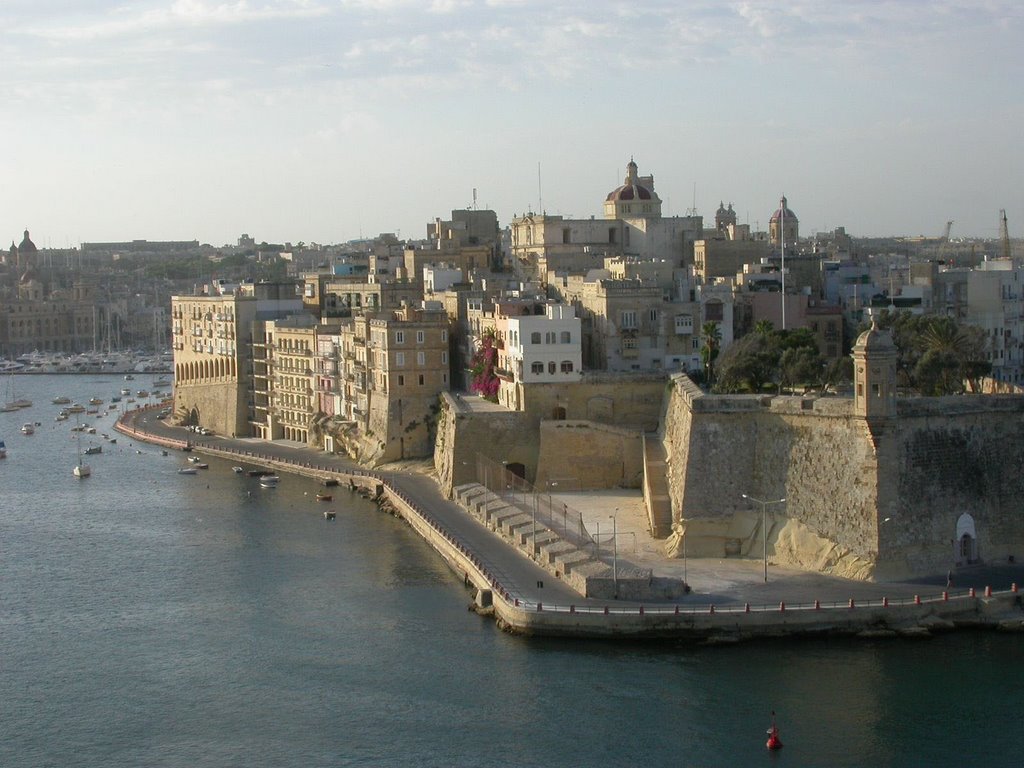
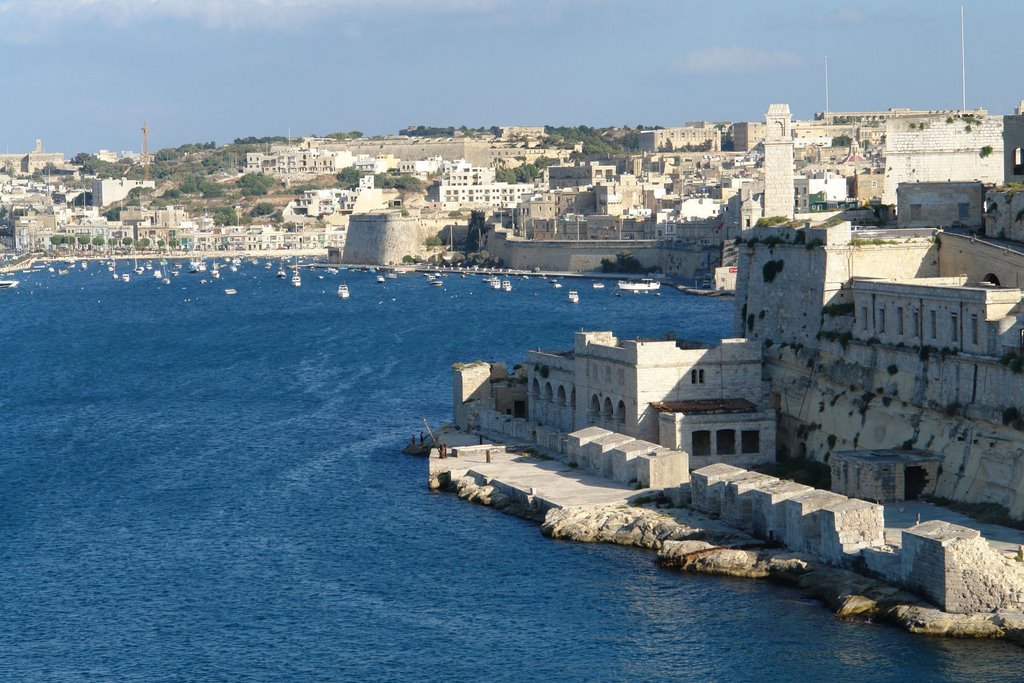
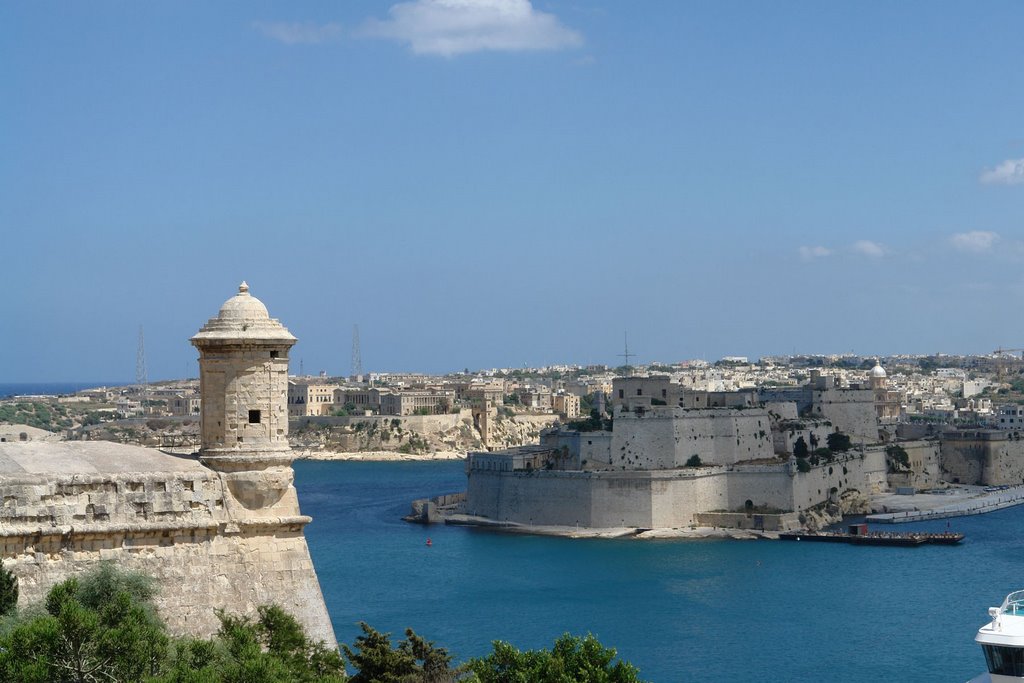
Entering Malta's Grand Harbour on a clear bright morning is an experience not to be fogotten. The city looks like it is hewn from solid rock, and much of it is. The walls and battlements are imposingly medieval and robust.
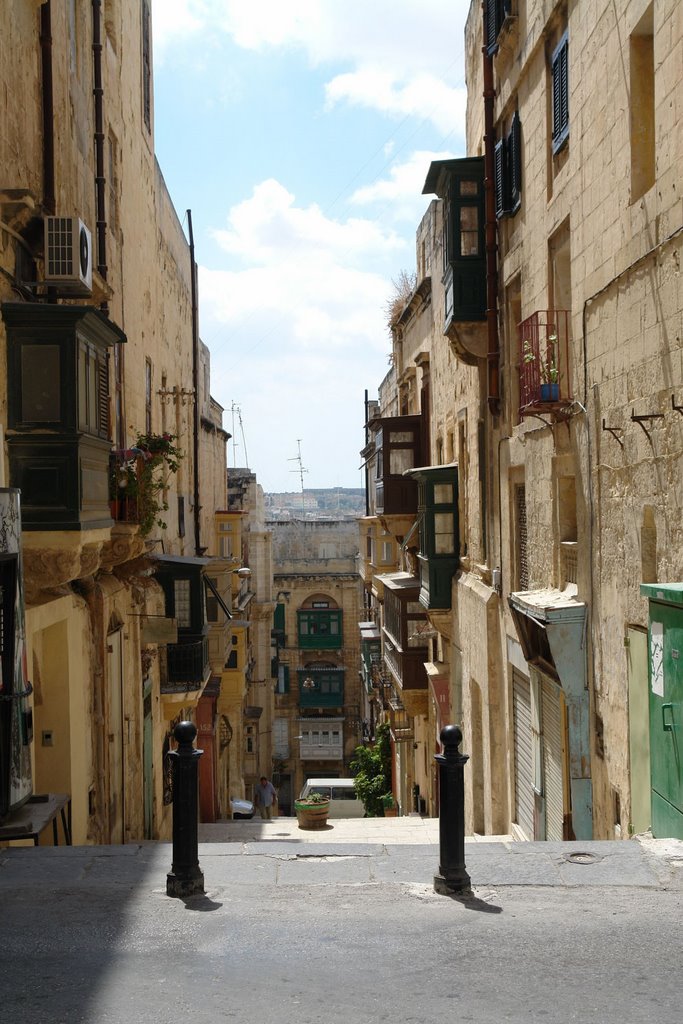
Valletta, Malta is a very small place, and the passengers from one large cruise ship like ours will be quite enough to fill its narrow streets, like a school of fish in a tiny aquarium. The architecture here is Mediterranean. Green-painted bay windows protrude from the houses, much like the ones in southern Spain or Morocco. In the floor of the great Co-Cathedral of Saint John of Malta lie the ornate and colorful sepulchres of the Knights Hospitaller (a.k.a the Knights of Rhodes, Knights of Malta, Cavaliers of Malta, and the Order of St. John of Jerusalem). Inside the Cathedral are two paintings by Caravaggio, which for themselves are worth braving the crowds in order to view. No pictures or videos allowed. Officious guards bark their admonitions at unwary tourists who do not see the posted Verboten sign.
Malta was once a British possession, and signs of the British presence are everywhere. The Maltese language is impenetrable. Some of their words have a lot of x's in them, and sound quite Arabic. Malta has some nice glass products, paperweights and such. Not quite Venetian, but charming nonetheless.
The weather continues to be glorious.
* * * * *
August 8.
Messina, Sicily. Ashore at 9.00AM, and found a telcom provider, where I made a call to Rome to be assured that the car will be there when we arrive tomorrow at Civitavecchia.
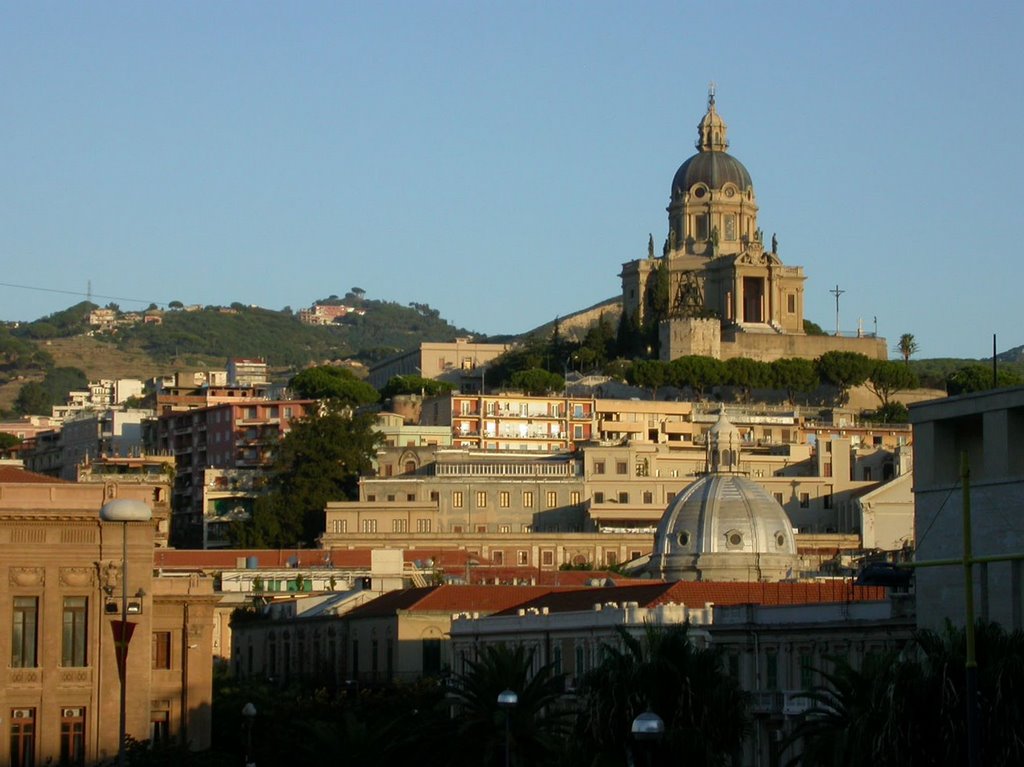
The dock is right by the city's municipal government building, and a short walk to the downtown and the Duomo, where at the noon hour crowds assemble in the piazza to watch the show in the belltower. There, on the stroke of twelve, a rampant gilded lion holding a banner begins to roar, several times; then a gilded rooster crows from the ledge one level down; below that a procession of gilded saints move past a seated image of the Almighty, each bowing in turn; while in a window a level below a house rises from the waves. I have no idea what the story is behind the show, and plan to research Wikipedia later to find out.
There are three cruise ships in Messina harbor. American voices are most prominent among the tourists buying shoes.
Sicilians are friendly and helpful. Romans less so.
What can I tell you about Ephesus. Here are some of the best-preserved ruins of ancient Rome. Great slabs of marble everywhere, including some of the streets. It must, in its time, have been a truly remarkable city. The guide tells our group that it was a seaport back then, but today the sea is a long distance away from Ephesus. We are led through the usual points of interest: the baths, the public toilets, the brothel sign, the magnificent façade of the Library of Celsius, and finally the amphitheater.
By this hour of the morning the sun is beating down mercilessly on the sweating polyglot tourists with their layers of sunscreen and wide-brimmed headcoverings. There is no shade except in the shadows cast by the columns — Ionic, Doric, Corinthian, whatever — or the occasional marble arch or lintel. Tour groups of twenty or thirty people gather around their guides, absorbing historical anecdotes in a half-dozen languages, and drinking bottled water. Each guide waves a plastic sign with a number to lead his or her group onward to the next station. Sometimes two or three groups are within earshot of each other, causing some confusion.
The Turkish tourism authorities have, in this writer's opinion, not yet attained the sophistication of their Greek counterparts in their efforts to promote tourism. There was a long wait to get through the electrically-operated turnstiles at the site, due to a power failure. They had to get an emergency generator started up to allow the throngs into the place. Each tourist was given one ticket, which served for admission but, more important, as the prepaid pass to the restrooms at the conclusion of the tour. Marble-lined W.C.s manned by unshaven old men with a bad attitude.
Kusadasi is a shopper's town. In Turkey they will try to sell you a carpet every chance they get. It seems everybody has a brother or uncle or cousin who owns a carpet factory, who can offer you a handmade carpet of the highest quality at a fraction of what you might have to pay at home. A visit to a carpet showroom is mandatory at the end of a Turkish tour. And if not carpets, then leather goods, or jewelry.
As I said, Kusadasi is a shopper's town.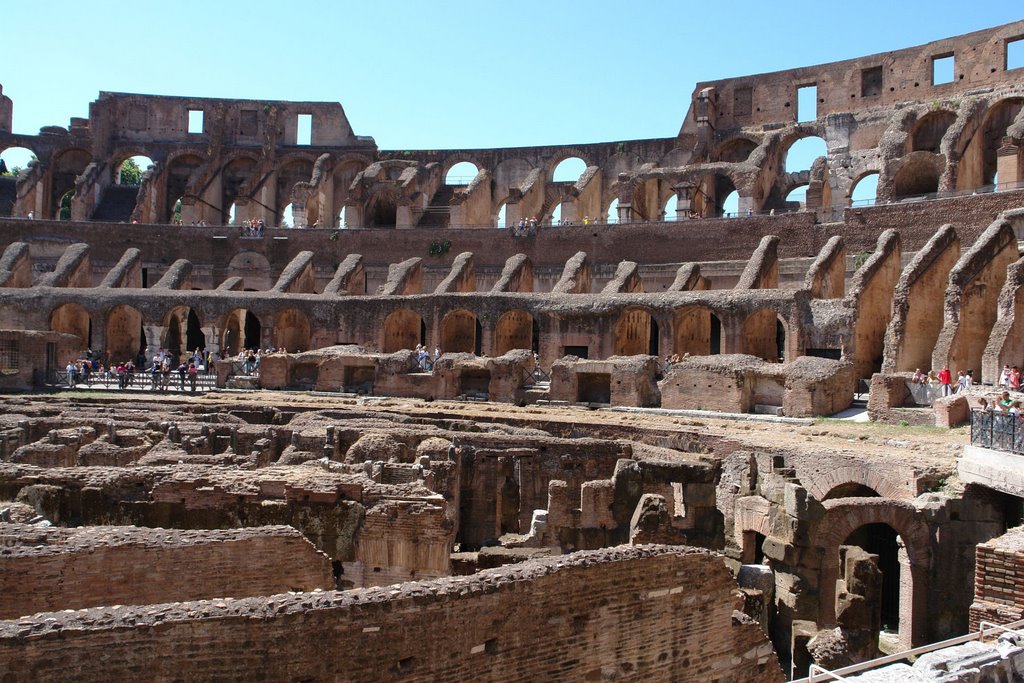


I thought I might start this account of our trip from the ending instead of the beginning. Reason is that a large part of the emotional excitement came at the end—if excitement it can truly be called.
I'm referring to the news, on the day prior to our return home from Rome, of the heightened airport security measures resulting from the discovery of a terrorist plot in Britain to blow up planes bound for the U.S.
Throughout the morning, the television in our hotel room kept up an alarming drumbeat of updates about new airport security requirements. No liquids, gels, or pastes of any kind would be allowed on carry-on luggage. Clear plastic bags would be used to carry passports and wallets on board. Anything else had to be placed in checked luggage. And calling the airline to reconfirm our flight or to seek updates required holding times of thirty minutes and more.
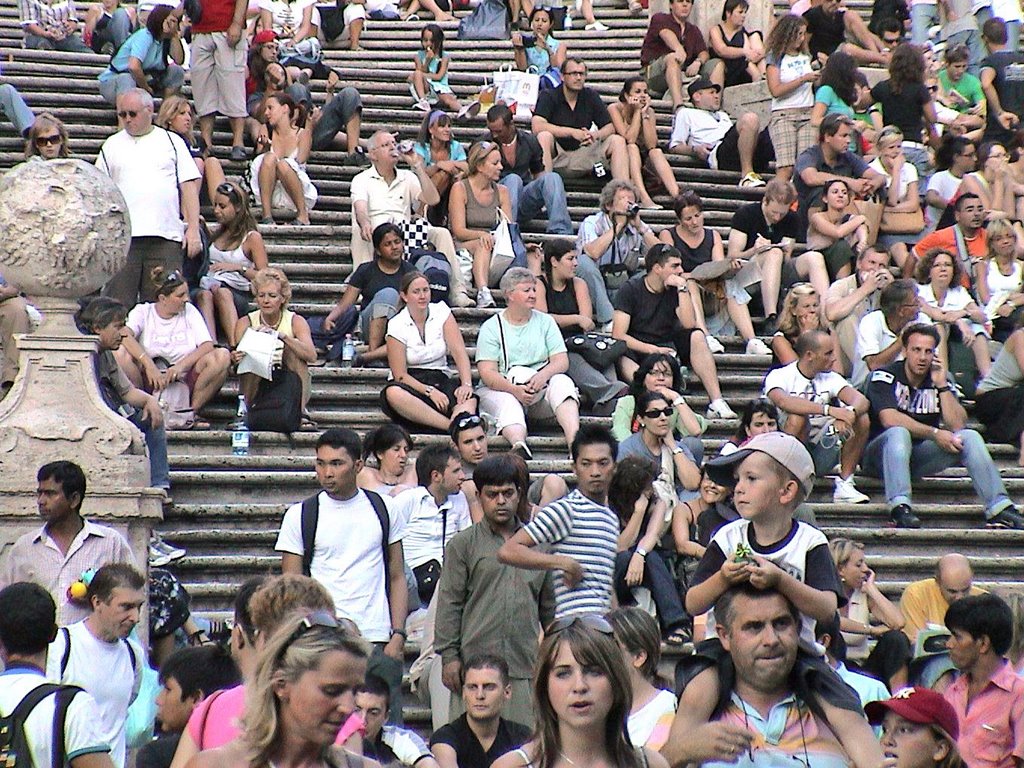
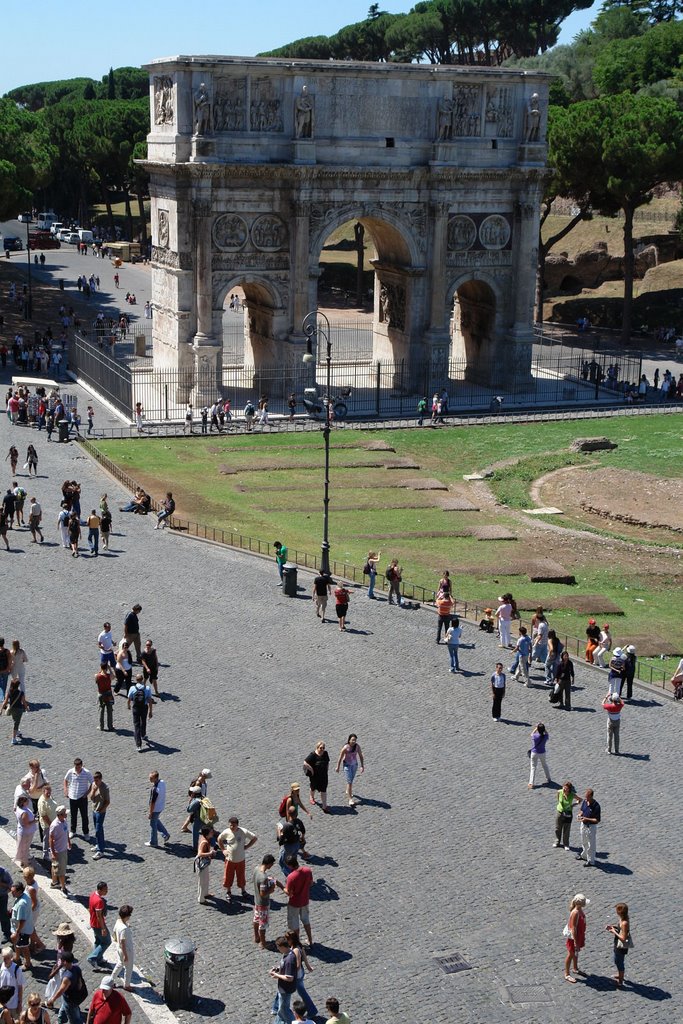
But later on, out there at the sweltering Colosseum the long lines of tourists waiting to get inside the famous landmark seemed remarkably nonchalant, as did the throngs sitting on every available Spanish Step in the golden glow of the late afternoon sun. Were any of these people thinking about terrorist plots or airline flight cancellations and delays? Not so far as any casual observer could tell.
Rome in August is typically empty of Romans, and filled instead with sweating sightseers from all corners of the globe. The sign 'chiuso per ferie' (closed for vacation) appears on one out of every two shops and restaurants in the Eternal City. Even His Holiness the Pope has gone off to the coolness of the Castel Gandolfo in the Alban Hills.
Rome was hot, hot, hot. But so were most of the other places we had visited during the previous ten days, starting from Civitavecchia.
Out floating hotel took us past the volcanic island of Stromboli and the Aeolian Isles, and then from the Tyrrhenian to the Ionian Sea through the Strait of Messina, past the Gulf of Taranto, and round the heel of the Italian boot into the Adriatic. By the third morning we were docked outside the ancient city of Dubrovnik, on the Dalmatian coast of Croatia.
All these seas are of course parts of the Mediterranean as any Italian schoolchild knows, and in color they share the various shades of deep blue for which this part of the world has been known from time immemorial. The "wine-dark sea" of the poets.
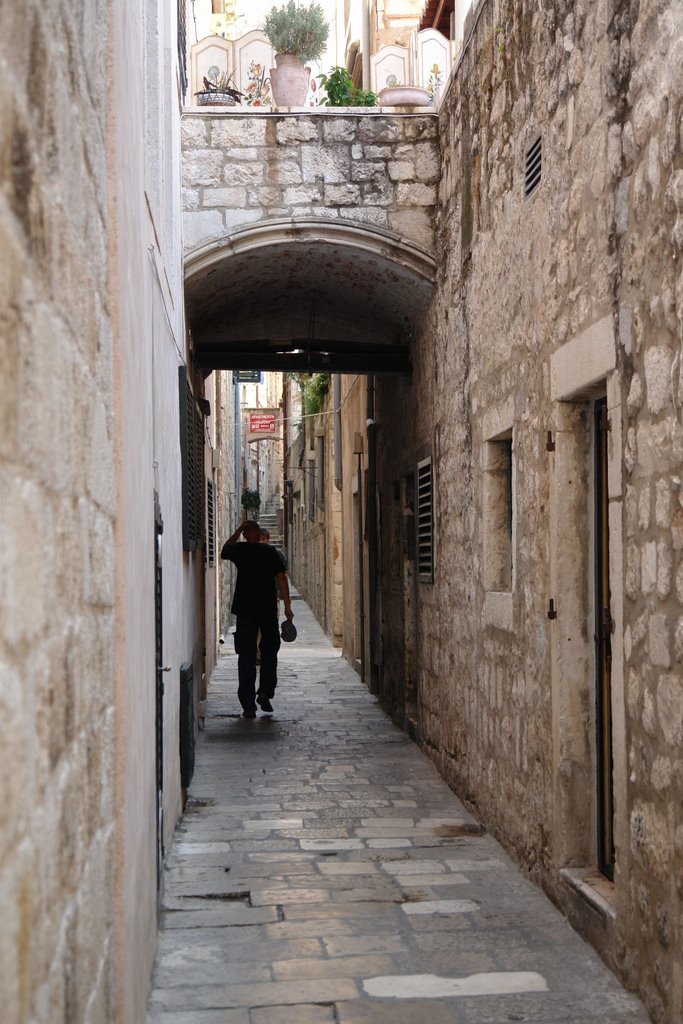
The Placa in Dubrovnik is just another shopping street, full of souvenir and t-shirt vendors, only more picturesque than most because of its stone achitecture and flagstone paving. Nowadays to walk along the city walls, you have to pay admission, something we had not done back in 1985 when we last visited, and when the place was still a part of the undisassembled Yugoslavia. Most of the damage from the war has been repaired, but here and there are signs of the recent conflict— a bullet hole in a marble wall, a patch on a tile roof.
In the evening, from the ship's rail, I watched the last busload of tourists return from a day-long side trip into Bosnia. Most of the weary passengers waved cheery goodbyes to the tour guide and her driver and trudged towards the gangway, but one elderly couple remained for several long minutes to have their picture taken beside the bus with the guide and driver. There were hugs and lingering farewells. It must have been, I assumed, a very memorable and edifying day for the visitors, who seemed reluctant to have it end. Then the smiling guide gave a final wave, signalled to the driver, and both boarded the bus. After the elderly couple had come aboard the ship, the gangway was pulled up. The ship then edged slowly away from the pier. And into the sunset.
Next stop on our itinerary was the Greek island of Corfu, or Kerkyra, full of the charm of its checkered past, its Venetian history, its stately mansions, and the open air cafes in the pleasant Spianada park. The sound of the cicadas filled the fragrant air with its steady hum. Tourists from the cruise ship scoured the shops, buying everything from jewelry to olive oil soap to plaster statues of Apollo. Many of our ship's passengers came from Spain, having boarded at Barcelona. Their lisping Castilian could be heard in Corfu's sidewalk cafés and coffee bars. They seemed to be quite at home here.
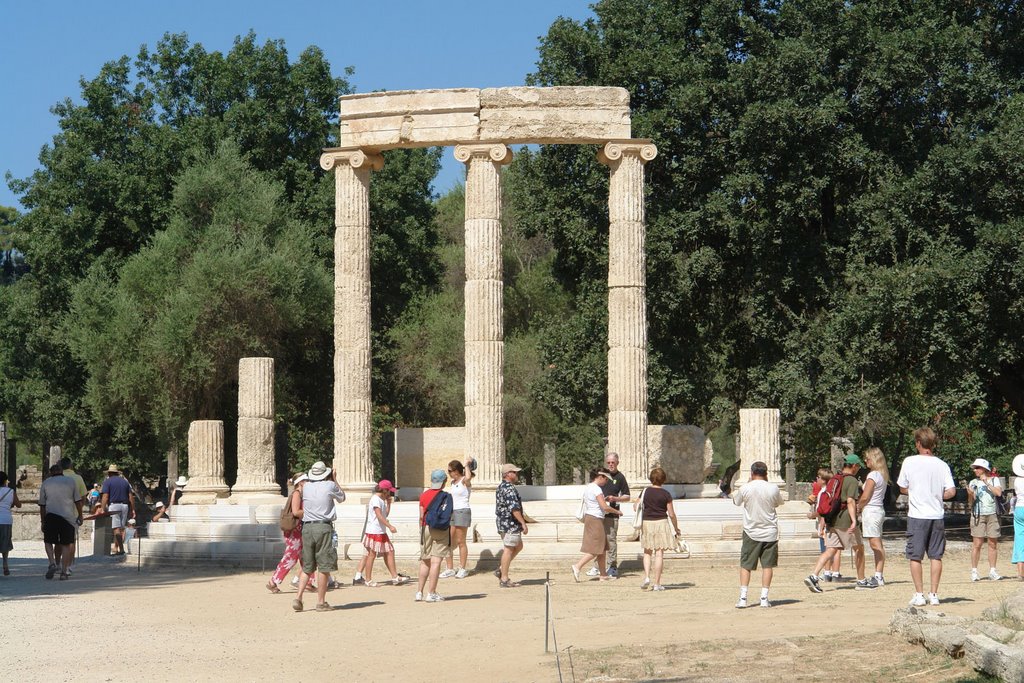
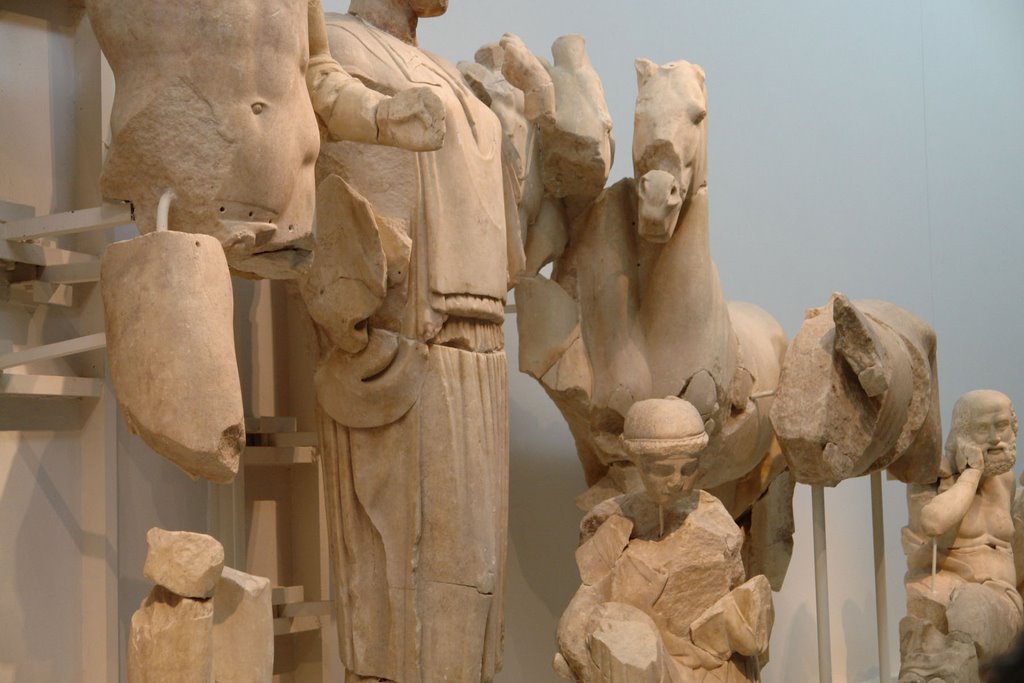
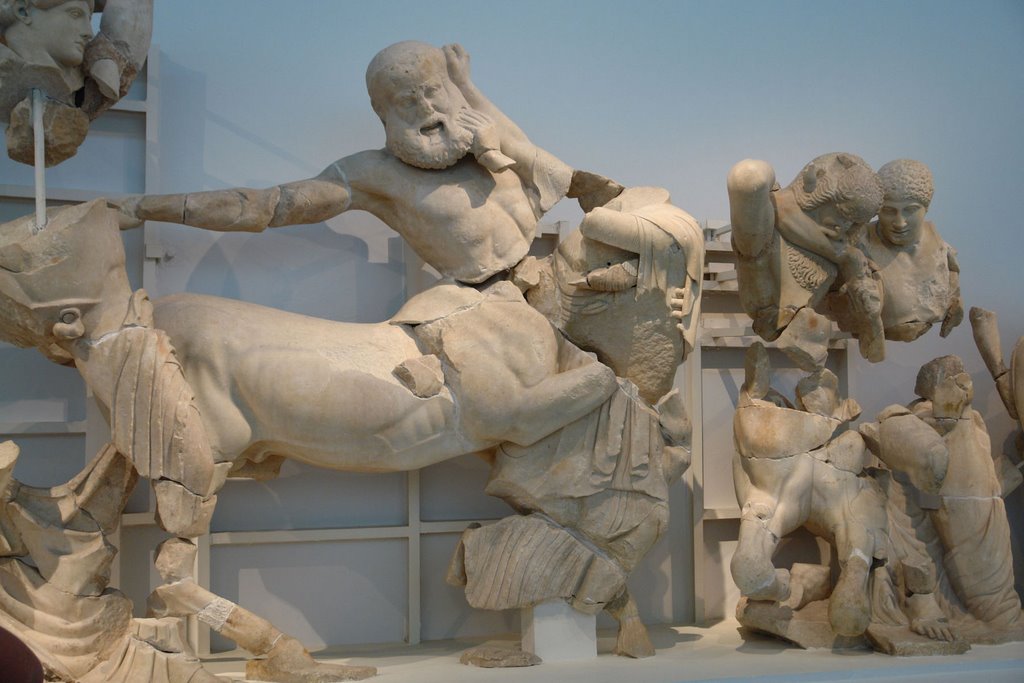
I had never heard of the Greek port of Katákolon until just before we left home on this trip. Now I know it as a small and pleasant village on the Ionian coast, not all that touristy just yet but slowly getting there, and the starting point for cruise line passengers up to the ancient city of Olympia. Olympia's ruins and the museum we had visited once before on a land tour, but for the kids it was exciting to see where the Olympic Games began.
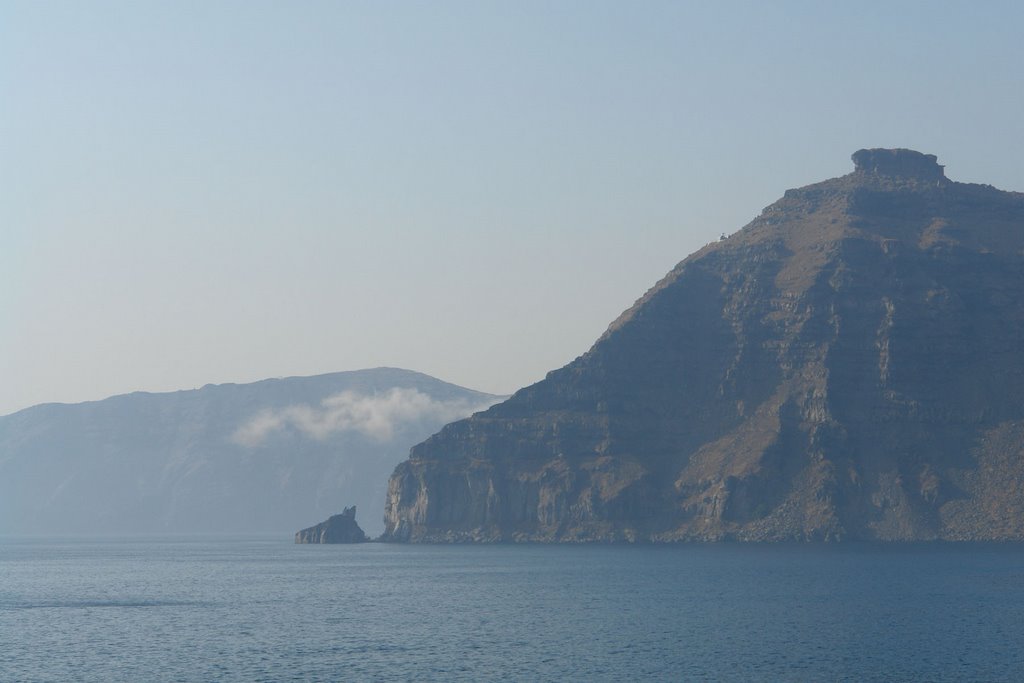
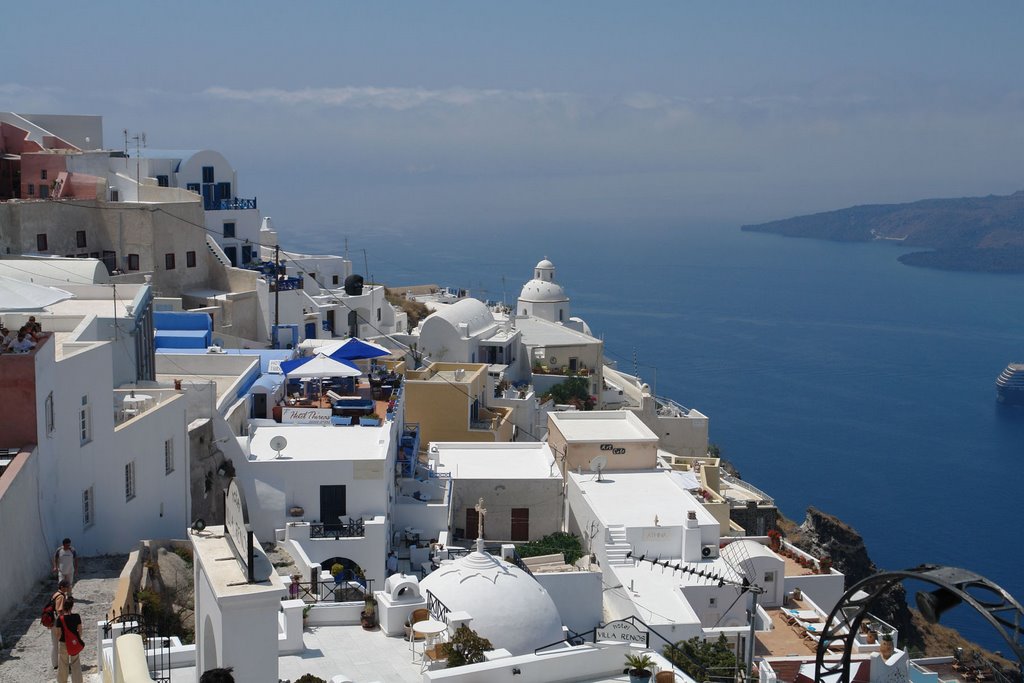
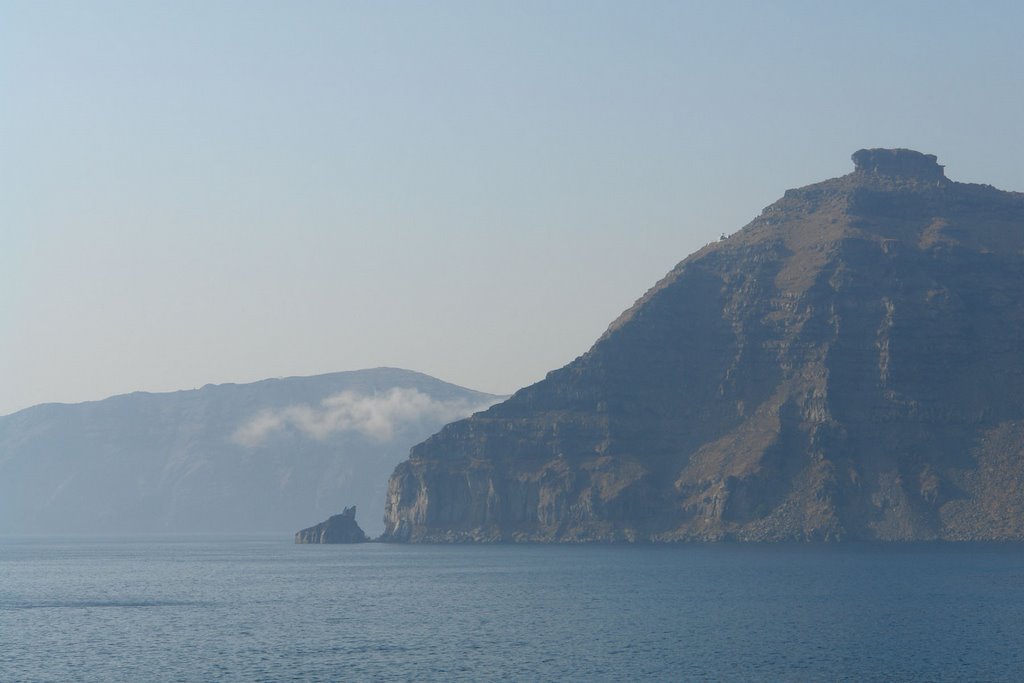
To arrive in the bay (actually the volcano's caldera) of Santorini in the morning is worth getting up early to witness. The bay is too deep for the ship to drop anchor, so it just sort of casually sits there in the middle, while a fleet of tenders come out from the base of the cliff to ferry passengers ashore. Then there's a funicular ride, or else a donkey ride, up the face of mountain to the volcano's rim and the town of Fira, from where you can take some of those spectacular photos that might end up on travel brochures and calendars — white cubist houses and blue church domes, and a sea of such beauty that one cares not to remember that it was created millenia ago by one of the mightiest cataclysms in that part of the world.
In the town itself we find the mandatory souvenir shops, and some excellent restaurants, along the narrow pedestrian streets. But farther away from the center the buzzing scooters, all-terrain vehicles, and cars, coupled with the traffic cop's shrill brass whistle, all combine with the crowds in the streets to produce noise pollution of Olympian proportions on an otherwise placid Aegean island.
The next morning we arrived in Kusadasi, Turkey, the jumping off point for a visit to the fabulous Roman ruins of Ephesus.
Well, now, let's save the rest of this travel diary for another day.