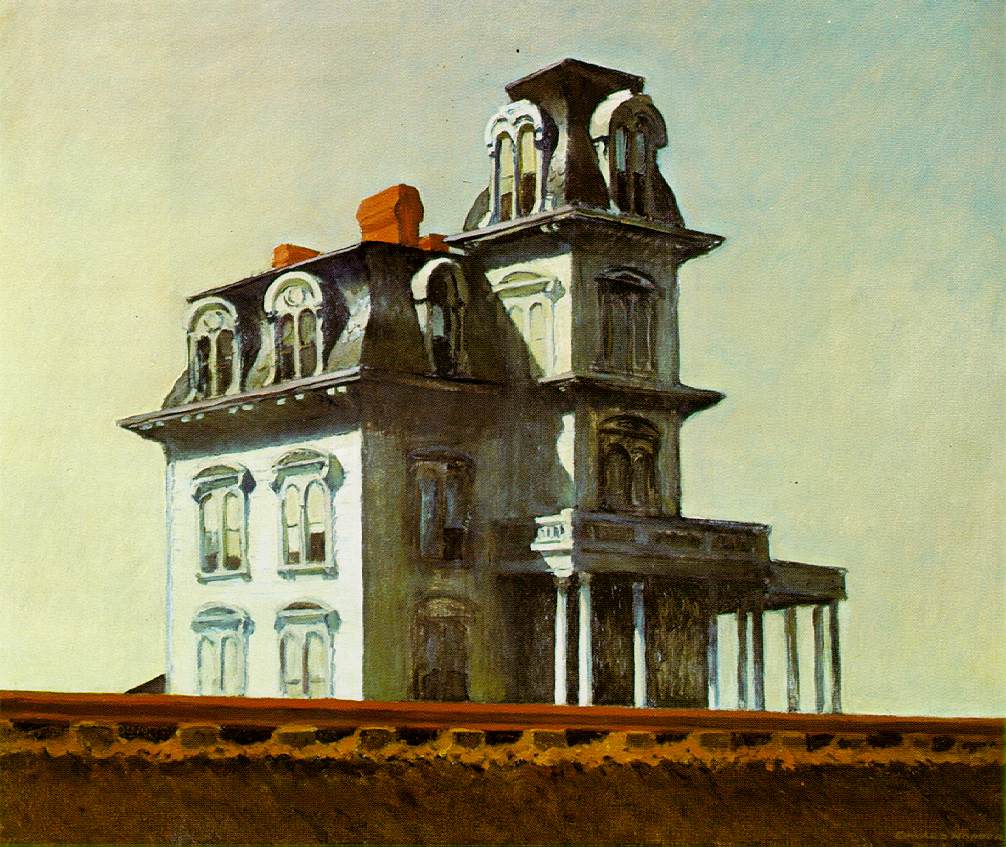
The Lighthouse
 The Cove


A compendium of images - most original, some not - words, and links, sometimes musical, gathered for the exclusive enjoyment of friends and relatives, some old, and some new.
 Temple of the Jade Buddha
 Butcher shop
 The steamed bun lady
 Glamor on the Bund
 Inside the Shanghai Museum
 High-rise apartment buildings
 Strollers on the Bund
Took a walk today, second one after a gap of many days. Laziness, mainly, and also somewhat less than good weather. Excuses, of course. But today the weather is gorgeous, though a bit warm in the sun. Hat needed, but forgot the sunblock. The scent of the mock-orange fills the air in the back yard. It's now a tallish tree, not the small shrub it was, oh, just a few years ago, and you actually get some shade under it. Speckled, though.
The bumble bees are active. Busy, as the saying goes. Interesting that they spend varying amounts of time in each flower. Here a sniff, here a longer sip or two, there a lingering guzzle. Same geranium pot, but I guess each flower is different.
Dragonflies are back. Maybe they're damselflies, the smaller ones, usually a bright blue. Their wings like what illustrators of children's books use on fairies. Tinker Bell too. Reading "Peter Pan" as a kid I thought she was only a minor character. But the fluttering damselfly wings in the Disney version made Tinker famous.
Funny how tastes change. Mickey Mouse was big when I was growing up. But for years now, "Mickey Mouse" has been synonymous with "trivial, of poor construction or shabby".
 View of San Francisco from Lincoln Park,
 A view from my friend Jim's living room window

The annual Lisbon Book Fair is one of the big events of the publishing industry. They hold the fair near the Marquês de Pombal square near the very top of Lisbon's Avenida da Liberdade, the wide boulevard that runs down from near the Botanical Gardens to the River Tagus. There are stalls upon stalls filled with books of all kinds, and thousands upon thousands of visitors.
This photograph is not directly related to the fair. It simply makes my point that the Portuguese love to read. Here on this train, which runs on a regular schedule from the Cais do Sodré in Lisbon all along the coast to the fashionable western suburbs of Estoril and Cascais, with stops along the way, are three men, all of them fully engrossed in their reading material (okay, okay, so one of them, the bald guy, is writing and not reading).
The young woman, the back of whose head occupies the left foreground, is not reading, though you can't tell from the photo, since all you see is the back of her head, her dark hair, and a glimpse of her shoulder. She is not reading, and she is rather attractive. She is attractive in a way that most men, young or old, if they were not blind, would be looking at her every chance they got, though out of decorum they would be doing it in a nonchalant and inoffensive way.
Portuguese men, in general, are exceedingly courteous, but even so, sitting there in close proximity to a charming young woman such as this one, they would not be immune to her charms. If they were not so deeply immersed in their magazine and notebooks, it is possible that a smile or a few innocuous words about the weather might be exchanged.
But trains aren't good places for complete strangers to strike up a conversation. And the simple expedient of reading a book or a magazine would certainly discourage anyone, even an attractive and bored young woman sitting alone, from attempting any small talk.
* * *
 Composition-wise, I think this picture is working. There is some cohesion, not to say unity, among the individuals in the shot, each minding his own business except for the gent on the right, who in midstep is casting a wary eye towards the photographer. The fact that the heel of his right foot is just clear of the ground gives the composition a tension, an expectancy. I could be prompted to suggest that it is like the Henri Cartier-Bresson shot of a Parisian man leaping over a puddle, but I would not go so far as to claim that this pic is in the same league as the master's. Click: Henri_Cartier-Bresson
So here in 1985 was my entertainment center. A Scandinavian teak wall system dominates one wall. Yep, I put it up myself, and it's still there, though everything else has changed. The speakers were U.S.-made Advent two-way bookshelf units, which I had owned since the Seventies. The books are now in my garage, having been replaced several times over by newer ones.
The long-play vinyl 33 rpm records on the shelf beneath the right speaker were mainly of classical music, probably alphabetically arranged according to composers' last names, as are my current crop of CDs. (In those days a name-brand classical LP cost around $6. Compare that to a good CD today; that is, if you can even find one!) Not to sound elitist, but truly my collection of classical pieces far outnumber the other stuff.
A Panasonic 19" television (still made in Japan at that time) with rabbit ears, no remote control, and only a very limited number of channels, sits on a stand with casters, that I had built myself in my garage workshop: a simple box, unpretentious, but nicely stained in mahogany and black, and varnished with satin polyurethane. Behind the TV, a framed print of Columbus's "Nina", "Pinta", and "Santa Maria".
On the chest of drawers left of the TV sits a Panasonic VHS videotape player. It has more buttons on its front than anything else. (A good blank videotape cost sixteen bucks back a quarter-century ago.) Next to the player is the Harmon Kardon stereo receiver, which we used about fifty percent of the time as an FM radio, and the rest for playing LPs. Radio was still pretty big back then. There were no remote controls for either the receiver or the VHS player, so you had to get out of your chair to twist knobs or push buttons, just as you did for the TV.
The phonograph, or LP turntable, was also made by Panasonic, but had the name Technics. It worked well, though you had to be careful that the arm was balanced so perfectly that the diamond point of the long-playing needle, manufactured by the American company Shure, made the lightest possible contact with the record in order not to damage or distort the grooves. Because dust can cling statically to vinyl records, there is a special felt roller brush that can be placed at the opposite edge of the turntable from the arm to clean the disc as it plays. It was a high-maintenance device to have to upkeep. The diamond needles needed replacement periodically, and they were not cheap.
I don't know what the black thing is that's sitting on the top of the turntable – probably a sweater that I had just taken off.
* * *
 The Red-and-White ferry is heading back to San Francisco
 A U.S.Navy ship glides beneath the Golden Gate Bridge heading out to sea.
 Chinatown, where almost every other shop is either a restaurant or a jeweler's store.
 The Chinese character in the middle is pronounced 'chook' in Cantonese. You know what 'chook' is, dontcha? That rice gruel that you eat with those delicious deep-fried crullers.
 This is either Jackson or Washington Street as evening approaches.
Every day at noon he arrives in the dining room of the private club. It is a ritual he has observed for decades. He walks slowly, with shuffling steps, but his back is straight, and on his way to his reserved table, he reaches a hand toward a chair-back to steady himself for a moment before proceeding.
There is a tired look to the imperious, heavy-lidded eyes, as his long fingers grasp the typewritten menu that the waiter has handed him. He scans the menu, but it is just a cursory inspection, for he orders the same meal every day: a bowl of tomato soup, chicken breast in a sauce béarnaise, two black olives and julienned carrots cooked with raisins.
The waiter pours ice water into his glass, next to which is a small dish with two slices of lemon pierced with a cocktail pick. The waiter dips the lemon in the water briefly, and then sets them back on the dish.
The old man's eyes survey the dining room, beginning at the entrance through which he had come, moving first to the left, then across to the right, where they rest on the two women who are sitting at a table next to the far window. The older of the two glances up from her soup plate, sees the old man, nods a greeting, then whispers something to her companion. The younger woman gazes momentarily at the man, displaying no sign of recognition, and resumes her meal without a word.
The old man knows who they are, knows, in fact, their family backgrounds as far back as three generations, knows that the older woman has debts well beyond her ability to repay, that her late husband also had a problem with managing his finances, that her children are good-for-nothing wastrels, and that the younger woman will be picking up the tab for this lunch and might even have been touched for a loan, perhaps not for the first time.
At a table by the wall, below large formal portraits of founding members of the club, sits another regular diner, a corpulent man in his late sixties. He has finished his dessert of blancmange, drained the last of his coffee, and carefully wiped his lips with his napkin. He looks up, appearing just at this very moment to notice the old man, and yells out a hearty greeting across the room. Then he gets up, picks up his golf cap, walks over to the table where the two women are sitting, and offers his compliments, which the older one returns with a labored smile. There is a brief introduction to the younger woman, and a gallant kissing of her hand.
The old man watches all this with Sphinx-like impassivity, his hooded eyes barely moving. He knows that the fat man has an enormous bar tab at the club, and the installment payments he has been making will barely cover his new purchases. He perceives that the fat man today did not have his customary two martinis at lunch.
Having finished with the two women, the fat man now approaches the old man's table. He has a slight limp. He is not invited to sit, and stands uneasily twisting his cap in his hands. The old man knows all the signs. He is quite prepared to deny the request he expects will issue from the fat man's mouth. The hooded eyes are raised to the ceiling. There is a curt sideways movement of the head. Negative. There will be no reinstatement of the fat man's credit at the bar, certainly not until the entire bill is paid in full.
The old man's chicken arrives. Without another word he begins to eat. The fat man stands there for a moment, then turns and starts to walk away. Several feet from the exit he stops, and retraces his steps to the old man's table. Again he hesitates. The old man does not look up from his meal. The fat man leans forward, whispers in the old man's ear.
The old man starts to cough and choke. Bits of chewed chicken fly out of his mouth. His face changes color, as the fat man backs away. A waiter rushes to the old man's side. The two women stare.